Isaiah A.
Sun view wellness is amazing place supportive come here to get the best care they take care of all your fears and worries.

Recovery has to work in the real world.
At Sunview Wellness in West Palm Beach, you live at home while you’re in treatment, so recovery gets practiced where your life actually happens. We look beneath the symptoms that brought you in, involve your family when it helps, and measure progress along the way.



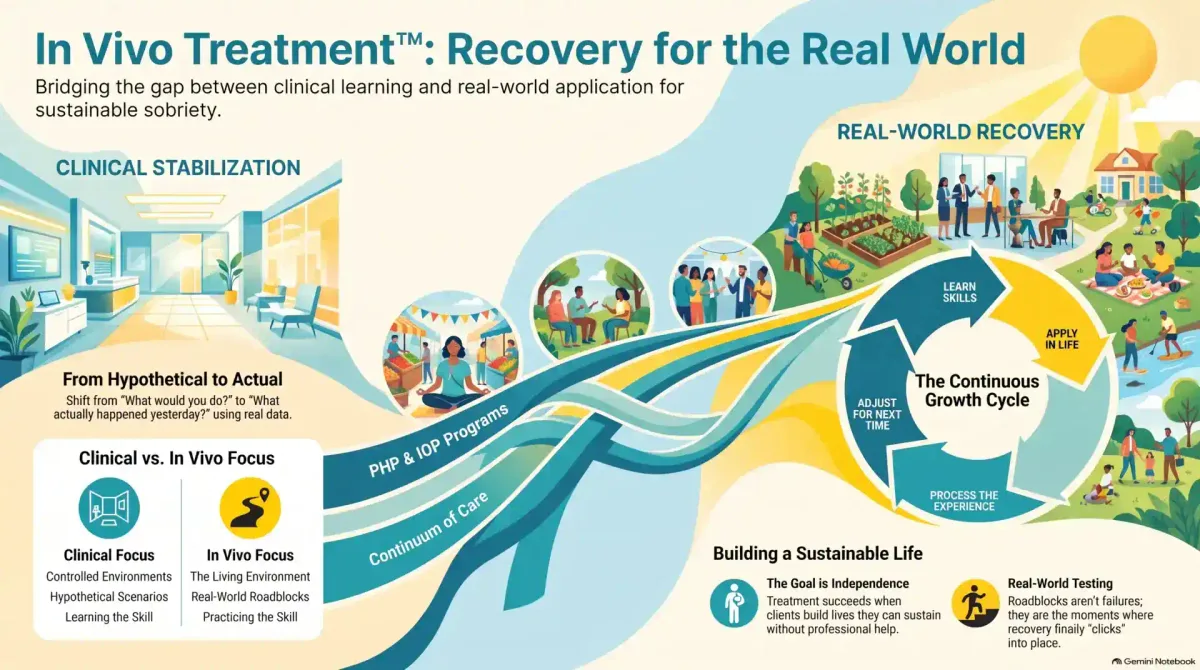
In vivo means “within the living environment.”
Detox and residential care provide safety, stabilization and a break from substances. Eventually, though, everyone in recovery faces the real test: can I stay sober while actually living my life? Recovery skills shouldn’t only exist on paper. At some point you have to practice them where your life happens.
01In the program
Skills for triggers, relapse prevention, emotional regulation, boundaries and communication.
02In your life
You go home, go to work and try those skills where your life actually happens.
03In your life
The argument with your spouse, the Friday night alone, the rough day at work.
04In the program
You bring what actually happened back to the program and talk it through.
05In the program
Together we look at what worked, what didn’t and what to try next.
06In your life
Back out with sharper awareness and another chance to practice.
Then around again. That feedback loop is the heart of In Vivo Treatment™.
In a controlled setting
In outpatient care
Hitting a roadblock isn’t a treatment failure. It’s often what makes treatment click. The goal isn’t to turn anyone into a professional patient: it’s to help you build a life you can sustain without us.
How In Vivo Treatment™ works in the real worldClinical Architecture™ is the framework created by our CEO, Frank Galimidi. Through it, he builds treatment environments that foster accountability, connection, structure and sustainable recovery.
Two of its ideas shape how we think about the treatment environment at Sunview.
What a treatment center should feel likeClinical excellence gives treatment its substance. Recovery culture gives that treatment somewhere to live.
“I = Sick” is the fear of functioning as a healthy adult once the sick role is removed. Our CEO, Frank Galimidi, names it as a main driver of repeat admissions, so we address it directly by helping people redefine themselves beyond the diagnosis.
The work deepens as you’re ready for it.
In PHP, IOP and OP you’re already living outside a treatment environment, which is exactly what makes deeper work possible over time. We don’t rush anyone into uncovering something painful simply because it exists. We build the foundation first.
“How do I get through this?”
Adjusting to the structure of programming, establishing sobriety, managing cravings or psychiatric symptoms, learning coping skills and starting to feel safe enough to engage. Asking anyone to unpack deeply rooted trauma at this point may not be realistic or clinically appropriate.
“Why do I respond this way in the first place?”
As you become more stable and build trust with your therapist and peers, we explore the patterns underneath the symptoms: relationships, family dynamics, past experiences, beliefs about yourself and emotional triggers. This is where IFS, psychodynamic and trauma-informed work can become especially meaningful.
“I can see it happening, and I have a choice about how I respond.”
Insight alone isn’t change. Here the deeper work connects with practical recovery skills, so understanding why you do something turns into recognizing it in the moment and responding differently.
Recovery isn’t linear. Difficult days, unexpected triggers and old patterns resurfacing don’t automatically mean treatment has failed. We use those moments therapeutically, so you can understand what happened and handle the next one differently. Read more about Internal Family Systems therapy and inner child therapy.
The symptoms that bring someone into treatment are often connected to deeper, unresolved struggles that developed and intensified over time. We value evidence-based practices, and we also look beneath the tip of the iceberg: the emotional experiences, relational patterns and underlying factors feeding substance use and mental health concerns.
Psychodynamic therapy explores how your past experiences, relationships and emotions shape the way you think, feel and act today. Inner child work looks at younger parts of you that may still carry feelings of being rejected, unsafe, criticized or not good enough. The point isn’t only to understand the past. It’s shifting insight into action.
In group, that work is supported by carefrontation in group therapy, supportive and honest feedback between group members, and by gender-specific groups every other Thursday.
Skills without depth can become a band-aid over a bullet hole.
Coping with triggers and changing harmful thought patterns matters, and we teach it through CBT and relapse prevention. But those tools hold better once you’ve looked at where the triggers and thoughts began. If people keep relapsing after treatment, something is missing. We look for the gaps in care and work to fill them.
Recovery is not only an individual process.
Our Clinical Director, Dana Martin, Ph.D., LMFT, is a couple and family therapist, and her systems-based training shaped the way the program was designed. Every member of a family plays a role in how the system works, even when those patterns aren’t healthy, and patterns can be carried from one generation to the next.
If we only treat the individual symptom, we may miss the system that keeps reinforcing it. Substance use and mental health concerns often affect the whole family, so we believe in family recovery.
When it’s clinically appropriate and you agree, your therapist contacts a loved one in your first week. From there, involvement can include weekly phone or email updates and family sessions every two weeks or monthly. Nobody is pressured into it. See how family therapy works at Sunview.
Success is more than finishing a program.
We look for meaningful progress in the areas that brought you in, along with more stability, functioning, insight and engagement in recovery. Progress looks different for each person, so we measure it along the way, and we use your feedback to evaluate ourselves too.
| Measure | What it looks at | How we use it |
|---|---|---|
| Brief Addiction Monitor (BAM) | What it looks at: Substance use, recovery and overall functioning, including both risk factors and protective factors. | How we use it: We want to see protective factors grow through treatment, a sign you’re building a stronger foundation, not only stopping use. |
| PHQ-9 | What it looks at: Symptoms of depression. | How we use it: Repeated over the course of treatment to show how symptoms are changing. |
| GAD-7 | What it looks at: Symptoms of anxiety. | How we use it: Repeated over the course of treatment alongside the PHQ-9. |
| Monthly treatment plan review | What it looks at: Your progress toward the goals you set with your therapist. | How we use it: Each month you and your therapist review what’s working, what still needs attention, and adjust the plan together. |
| RSA-R Consumer Satisfaction Survey | What it looks at: How you experience our programming: what helps and what could be better. | How we use it: We review the feedback and use it to make changes to the program. |
Your care doesn’t just stop at the door.
The goal is for you to leave with more stability, insight, practical recovery skills and ongoing supports, so you can keep making progress outside of Sunview.
At discharge
Your team recommends the supports to stay connected to after you leave, such as an individual therapist, psychiatric care and sober support meetings.
After discharge
You can keep seeing your Telemed Clinix provider for psychiatric care and medication management, so that part of your care doesn’t reset when the program ends.
Follow-up outreach
Our team reaches out to ask how you’re doing: whether you’re still connected to the supports recommended at discharge, whether you’ve maintained your sobriety, and how life is going overall.
Ongoing
What people tell us helps us strengthen our discharge planning and continuing-care recommendations.

Isaiah A.
Sun view wellness is amazing place supportive come here to get the best care they take care of all your fears and worries.
Angel V.
Very helpful and attentive people who care to see you get better through your rough time in life.
Stacey P.
If you are struggling with addiction, this is the place that will make you feel like home. The therapist are amazing in their own unique ways. Group sessions become your best friends in the circle. They are welcoming to any type of addiction, they are loving, and strong therapists.
Henry E.
It was the most rewarding experience I've had in such a long moment of time! The knowledge and expertise of the staff was immeasurable, of high quality and refreshing! A special shout out to Jillian my therapist, Carissa and Frank! This by no means is meant or intended to take from the excellent job done by each individual employee and Sunview. I'm not the type that would just throw around gratitude lightly! Last but not least, I want to give a shout out to all my peers and all participants of Sunview, for their unselfish willingness to surrender and assist the healing and recovery of others! God bless you! Love, Henry Edwards and Tiffany Cunningham!
Julie V.
Sunview Wellness was the icing on the cake in my mental health journey and recovery and it honestly changed my life for the better..This program was outstanding in the approach they implement to help all of their clients. The important thing is you have to really want the help and do the work to get where you want and need to be. I believe participation in the group therapy is essential even though it may not be easy at first. Every single person that works at Sunview Wellness is caring and really wants everyone to get well. Laura Contreras was my therapist and she is one of the most caring empathetic individuals I have ever come across. She was truly the right therapist for me. Mia stood out to me ( even though everyone was good) as an excellent group facilitator . Karissa Delaney the office manager was always a welcoming face in the morning. She was always willing to help out with any concerns or questions that I had. I was actually sad when my time came to leave Sunview even though I was ready. I made many friends and enjoyed the interaction with other people that GOT IT with NO JUDGEMENT! And Finally thank you Frank for overseeing and having such a wonderful place for people to come and heal. I’m forever greatful. 😊💕
Carmela S.
I would like to share my experience by telling everyone what a great program this is and how much my life has changed due to this wonderful program. The staff is great and there therapist are very thorough and supportive.
Your Community. Your Recovery.
A true outpatient model for real life. Call or send a message: we listen first, check your insurance for free, and help you work out the right level of care. Free door-to-door transportation is included.